WRI identifies key elements for a successful
and possible outcome in Copenhagen In December 2009, twenty thousand people, including about 40 heads of
state, will converge in Copenhagen to decide how the world responds to escalating
climate change over the next half century. If successful, the meeting of 192 member countries of the UN Framework Convention
on Climate Change (UNFCCC) will send a clear signal to business and
industry, governments and citizens around the world. Commitments made and
mechanisms agreed will signal that the future belongs to a low-carbon economy
and that tomorrow’s winners will be those that invest in clean energy solutions.
It will also set in motion swift support for the most vulnerable in adapting to a
warming world. Copenhagen should serve as a foundation for and springboard to a new legally
binding global climate agreement. Realistically, the summit is likely to result in
a foundational outcome that encourages immediate action to reduce emissions
and signals commitment to greater action in the near future. The negotiations
are likely to conclude in a series of decisions that will lock in progress made so
far, together with an overarching high-level political declaration that the final
agreement will be legally binding. This new, comprehensive, and legally binding
instrument will be the goal of negotiations in 2010, once the United States
has passed the domestic legislation necessary to commit to a final target and
timetable for reducing greenhouse gas emissions. This brief paper, rooted in WRI’s long-running analysis of the complex and interconnected
issues under negotiation, identifies key elements for a successful
and possible outcome in Copenhagen (categorized in this document by The Big
Picture Agreement, Building a Sound Foundation, and Support for Developing
Countries). These include a clear set of follow-on negotiations to complete a
legally binding agreement. This process could be achieved in two stages - at a continuation of the COP 15 Copenhagen session six
months later (a so-called COP 15 bis), and at the next full
conference of the UNFCCC parties (COP 16) in Mexico in
December 2010. Putting in place a clear process to agree
upon the final legally binding instrument(s) in one negotiation
track will be key to success. After two years of negotiations,
many of the elements required for an effective
post-2012 climate agreement are already clear. The world sets a goal to keep global average temperature
below 1.5–2 degrees Celsius in comparison with pre-industrial
levels. This is in line with the best scientific guidance which warns that greater warming will spawn increasingly
dangerous and unpredictable impacts. To limit temperature
rise, countries also agree to reduce global emissions by at
least 50 percent below 1990 levels by 2050. In order to meet this goal, a high-level declaration would
contain a set of substantive agreements in the form of
targets and timetables from developed countries and emission
reduction actions by developing countries. Financial
commitments from the former to support the latter in their
mitigation and adaptation efforts between now and 2020
must also be included. Developed countries as a group — including the United
States, 27 European Union countries, Japan, Australia,
Canada and Russia — would commit to reducing emissions
by at least 80 percent by 2050. These countries would also commit to cutting collective emissions by 25 to
40 percent below 1990 levels by 2020. Additionally, each
developed country would also commit to an economy-wide
2020 emission reduction target (known as a Quantified
Emission Reduction Commitment or QERC) and an emissions
pathway through 2030. These national targets could
be in the form of a range until the final legally binding
instrument(s) is agreed in 2010. Developing countries would agree to take nationally
appropriate climate mitigation actions that will reduce
emissions significantly (e.g., 15 to 30 percent) below
business-as-usual levels by 2020. African, Asian and Latin
American governments could implement emission reduction
policies and measures in all major economic sectors,
including forestry (deforestation is responsible for 15
percent of global greenhouse gas emissions). Some large
developing countries that are major economic players and
substantial greenhouse gas emitters, such as China, Brazil,
and Mexico also would agree to individual non-binding
goals to curb national emissions within the range. The
amount of financial support that developed countries come
up with will fundamentally determine the level of action to
which developing countries are prepared to commit. Country actions and commitments would be reflected
in long-term nationally appropriate low-carbon planning
processes. For these commitments to form the basis of an effectively
functioning agreement, a framework of international
climate machinery needs to be built around them. This
will require a COP decision mandating that negotiations
conclude in a legally binding instrument that contains the
following specified mechanisms and institutions. All countries’ commitments and actions would be formally
registered at Copenhagen which requires creation of an
official registry or schedule. These could be amended post-
Copenhagen only in order to make them more ambitious.
Support pledged by developed countries for developing
country actions would also be included. When the post-2012 international climate agreement
comes into effect, it is critical that countries employ both
common methodologies to track greenhouse gas emissions
and common international accounting standards. Without
such rules, comparing emission reduction actions taken by
different countries will be like comparing apples and oranges.
Such rules will also be important to enable a global
carbon market to operate effectively and help drive down
the cost of climate change mitigation. The agreement would therefore include common international
accounting and reporting standards for countries taking on targets in four key areas: 1) comprehensive
reporting and review of national GHG emissions; 2) common
standards for quantifying, reporting, and reviewing
emission reductions, including from changes in land use,
land-use change, and forestry; 3) common standards for
national GHG registries and 4) common methodologies for
estimating emission reductions from developing country
projects or programs funded by developed countries
(known as offsets). A robust mechanism to measure, report and verify the
commitments and actions that countries agree to take is
critical to promote trust between nations, and to ensure
that promised greenhouse gas reductions actually materialize.
This would include deployment of expert review teams
to assess country efforts. Delivery of the support that
developed countries pledge to developing countries would
also be measured, reported and verified. An Implementation
Committee would be established, providing a forum
for expert review teams to share findings with countries. The UNFCCC Conference of the Parties could be mandated
to encourage countries to meet their obligations and
empowered to find a country out of compliance. Tools to
encourage compliance could include possible suspension
of a country’s rights and privileges under the agreement. It is critically important that the Copenhagen agreement
remains consistent with the latest science on climate
change. This will require institutionalized reviews to help
ensure that countries’ collective commitments meet the
objectives the world has set. The first would review countries’
efforts in light of the latest IPCC review of science
in 2014. Further emergency reviews could be triggered by
a group of countries if new scientific evidence warrants
swifter attention than scheduled in the agreement. No deal will emerge from Copenhagen, or subsequently,
without significant commitments of financial, technology
and capacity building support from industrialized to
developing countries. This requires two decisions. The first
is particularly important both to build trust and respond
to urgent need, and is a fast start fund to help the poorest
countries respond to the existing destructive impacts of
climate change on lives and livelihoods and build capacity
to act. The second is a decision to create the post-2012 financial architecture and identify sources of funds. WRI
views the following mechanisms and support frameworks as
a workable solution. A new financial mechanism created in Copenhagen could
establish a single fund with four components - adaptation,
technology, mitigation and forestry. The most vulnerable
countries would have direct and expedited access to this
money, which would have robust transparency and accountability
rules attached. Developed and developing
countries would be equally represented on the fund’s governing
boards, which would fall under the authority of the
Conference of the Parties to the UNFCCC. The financial
mechanism could include a role for existing but reformed
international financial institutions. Fast start fund This new mechanism would be immediately
operational with annual prompt start funding of $10 to $15
billion pledged by developed countries in Copenhagen for
adaptation and capacity building from 2010 through 2012. Longer term funding Developed countries would commit
to deliver substantially larger amounts by 2020, with a
specific figure to be agreed upon in 2010. Sources could
include domestic cap-and-trade programs which provide
set-asides for the aforementioned public funds, and perhaps
bunker fuel levies on international aviation and shipping.
All countries would contribute to the fund – based
on responsibility and ability to pay – except for the poorest
and most vulnerable. Additional and predictable financing
must be earmarked for climate change by industrialized
countries, and not diverted from official development assistance
budgets. Countries would agree to take and support actions that will
significantly reduce emissions from deforestation and significant
forest degradation (known as REDD) in natural forest
ecosystems by 2020. This would require agreement on
the creation of a REDD mechanism at Copenhagen. This
mechanism would initiate and direct performance-based
financing that reflects the varied national circumstances
and needs of individual developing countries. A first phase
would channel financing for policies and measures leading
to improvements in governance of forests that are
necessary for countries both to achieve emission reductions
and to provide credible emission reductions into an
international system. A second (and possible subsequent)
phase(s) would channel support for countries to achieve
real, additional, verifiable and permanent reductions in
greenhouse gas emissions. Reporting and verification
components of the REDD mechanism would include tracking
governance improvements and emission reductions.
Impacts of activities on biodiversity and the rights of
indigenous peoples and local communities would also be
monitored. forest degradation in developing countries This new mechanism would seek to speed the deployment
of clean energy and low-carbon technologies in developing
countries. Countries would decide to double climate
research and development funding by 2015 and include
innovation and capacity building centers in developing
countries. Countries would also create a mechanism to
handle issues surrounding intellectual property rights
(IPR). In addition to the fast start funding, a new adaptation
framework would be agreed at Copenhagen that promotes
both immediate and long-term integrated action by all
countries to adapt to the impacts generated by rising global
temperatures. This would provide reliable adaptation
support for all developing countries, with the most vulnerable
first in line. Assistance will support development of
planning and review processes, building of institutional capacity,
implementation of practical on-the-ground projects,
and scaling up of action through international cooperation
networks and initiatives. There are two tracks of talks under the UN negotiations,
one within the UNFCCC and one within the Kyoto Protocol.
Many countries (especially from the developing world) seek
to maintain and strengthen the Kyoto Protocol while others,
notably the United States, would prefer to work solely
within the UNFCCC framework. As a result, countries may
fail to decide at Copenhagen on the final legal form of a
binding new climate agreement. Specifically, they may not
agree whether there will be one new legally binding agreement
or two, with the Kyoto Protocol continuing for those
that are parties to it and a separate agreement for others. If this is the case, countries must set a date by which
such an agreement will be concluded, and a clear, timely
process to complete the negotiations. To be most effective,
this should include continued involvement of ministers
and heads of state and be focused in one track of negotiations
to decide the final legal instrument(s). To expedite this process, countries could decide in Copenhagen
that two high level meetings of the Conference
of the Parties to the UNFCCC are needed next year. The
first would be a continuation of COP 15 and take place
in June 2010. The second would be the regular annual
COP meeting in December in Mexico. If the key elements
described above are put into place at Copenhagen, they
would provide a springboard to finalize a new, long-term,
and effective global climate agreement in 2010. Download the PDF (PDF, 6 pages, 347 Kb)
Read more [wri.org]
WASHINGTON (Reuters) - When President Barack Obama and India's prime minister meet next week to talk about climate change the leaders will focus on green technologies rather than narrowing the global divide on greenhouse gas emissions goals, the chairman of the U.N.'s climate science panel said.
Read more [Reuters]
BERLIN (Reuters) - World leaders cannot afford to leave a U.N. summit in Copenhagen next month without a robust agreement to fight climate change, German government climate adviser Hans Joachim Schellnhuber said Friday.
Read more [Reuters]
OSLO (Reuters) - Shipping is slowing climate change by spewing out sunlight-dimming pollution but a clean-up needed to safeguard human health will stoke global warming, experts said Friday.
Read more [Reuters]
UNITED NATIONS (Reuters) - The U.N. environmental chief called on rich nations on Thursday to pledge $10 billion a year for three years at next month's Copenhagen summit to help poor states begin to tackle the impact of climate change.
Read more [Reuters]
Irish Times: NEVER WAS a global conference so hyped up as a make-or-break event as the UN climate summit due to take place next month in Copenhagen. As 15,000 participants, plus many more observers, made their travel arrangements, the stage seemed set for a historic agreement that would start the recovery for a world staring into the abyss of dangerous climate change. Responsible groups throughout all 192 countries participating in the event had done their bit to sensitise those in authority as to ...
Read more [EcoEarth.info]
Agence France-Presse: World Bank chief Robert Zoellick said Wednesday it was critical for indigenous people to be included in climate change talks, saying they were among groups most affected by global warming. Two weeks before the opening of a major United Nations conference on climate change in Copenhagen, Zoellick said indigenous peoples carried a "disproportionate share of the burden of climate change effects." He spoke at a Washington roundtable that brought together native and tribal group ...
Read more [EcoEarth.info]
Irish Times: WOMEN IN developing countries are the most vulnerable to the effects of climate change, but their plight has been largely overlooked in the debate over how to tackle the issue, according to a United Nations report published yesterday. The UN Population Fund (UNFPA) report, Facing a Changing World: Women, Population and Climate Change, details how climate change threatens to widen the gap between rich and poor and amplify gender inequalities. Slower population growth in both developed ...
Read more [EcoEarth.info]
Time Magazine: But a new paper published in the Nov. 19 issue of Nature demonstrates that the oceans' ability to absorb man-made carbon may be dwindling -- and that has worrying ramifications for future climate change. While the ocean is now absorbing more carbon in total than ever before, the waters are sucking up a smaller percentage of the CO2 emitted by humans. That could mean that there's a limit to the ocean's capacity -- and that we might be hitting it. (See the top 10 green ideas of ...
Read more [EcoEarth.info]
Special Broadcasting Service: There's a 'high chance' a heatwave sweeping Australia's southern and eastern states is related to climate change, a scientist at the Bureau of Meteorology says. Climate Meteorologist Harvey Stern says the scorching weather effecting parts of South Australia, Victoria and New South Wales at this time of the year is rare. "This (the heatwave) is a truly extreme event," Dr Stern says. "Many places have established all-time records for the first half of November." The ...
Read more [EcoEarth.info]
Independent (UK): The prospect of a hungry century looms. On our present course, we are caught in a pincer. Climate change is likely to turn much farmland around the globe into desert. And the growth of the global population will increase demand for food. Yields will fall and prices will rise. That is a recipe for starvation. Professor Robert Watson, the chief scientific adviser at the Department for the Environment Food and Rural Affairs, argues in an interview with this newspaper today that the ...
Read more [EcoEarth.info]
New Kerala: Expressing apprehension that the coming Copenhagen meet for hammering out a Climate Change agreement was heading towards a flop, Minister of State for Environment and Forests Jairam Ramesh today said India must take aggressive and proactive domestic measures to cut its greenhouse gas emissions irrespective of what happened at international fora. ''These are the paradigm shift I have been calling for during the last few months,'' Mr Ramesh said speaking after releasing the UN's State ...
Read more [EcoEarth.info]
Times of India: Leave aside a binding agreement on climate change, the 190-country Copenhagen conference on December 7 is unlikely to throw up even a political statement of high-sounding sentiments on the need to save the planet -- a statement, which countries were hoping, would give the direction for hammering out an agreement next year. The setback came in the just-concluded two-day ministerial meeting at Copenhagen on November 16-17, where persistent schisms on even most basic things such as a ...
Read more [EcoEarth.info]
Reuters: ndia's prime minister and U.S. President Barack Obama meet next week to strengthen ties, with the emerging Asian power increasingly playing a bigger role on global issues such as climate change and trade. Manmohan Singh's three-day state visit starting on November 23 is seen by New Delhi as a touchstone of Obama's intention of sustaining a relationship that deepened under his predecessor George W. Bush. India is also widely seen as a key geopolitical player in helping bring ...
Read more [EcoEarth.info]
Reuters: Australia's government demanded on Thursday that conservative rivals stop opposing carbon trade laws, citing a heatwave searing the country's biggest cities as evidence of Australia's vulnerability to climate change. With Australia on bushfire alert, the government said record temperatures above 40 degrees Celsius (104 Fahrenheit) across three states this week showed the need to act urgently against climate change. "November this year has seen a long and intense heatwave across ...
Read more [EcoEarth.info]
Washington Post: CLIMATE CHANGE was at the top of President Obama's agenda in China Tuesday, just three weeks before representatives from 192 countries meet in Copenhagen for a much-anticipated international climate conference. And he came tantalizingly close to saying what the rest of the world has been waiting years to hear: that next month the United States, the largest per capita emitter of greenhouse gases, will finally come to the table with a specific carbon reduction target. In a news ...
Read more [EcoEarth.info]
GMA: Effects of climate change have driven women in communities in coastal areas in poor countries like the Philippines to risk dangerous jobs, and sometimes even into the flesh trade. Suneeta Mukherjee, country representative of the United Nations Food Population Fund (UNFPA), said women in the Philippines are the most vulnerable to the effects of climate change in the country. "Climate change could reduce income from farming and fishing possibly driving some women into sex work ...
Read more [EcoEarth.info]
Agence France-Presse: Braking the rise in Earth's population would be a major help in the fight against global warming, according to an unprecedented UN report published on Wednesday that draws a link between demographic pressure and climate change. "Slower population growth... would help build social resilience to climate change's impacts and would contribute to a reduction of greenhouse-gas emissions in the future," the UN Population Fund (UNFPA) says. Its 104-page document emphasises that ...
Read more [EcoEarth.info]
Has cap-and-trade in Europe worked? WRI’s Senior Fellow Jill Duggan, who helped implement the EU trading scheme, sorts the myths from reality. Europe began its cap-and-trade system in 2005, with a three year learning period (phase 1). In recent U.S. Senate climate hearings, cap-and-trade critics pointed to the challenges of that first phase as a sign that cap-and-trade was a failure. But as more results are identified and understood, Europe’s first phase is looking more and more like a success. Today Europe has a stable cap-and-trade system, improved by the lessons learned when it was first implemented, and industry in Europe have certainty that carbon pricing is here to stay. Price volatility for carbon is often cited as a problem in the EU Emissions Trading System (ETS). In fact, for the second trading period, the price has been relatively stable. The chart below shows the comparative stability of European Union Allowances (EUAs) – the emissions reduction ‘currency’ (in blue) – when compared to the price volatility of other commodities such as coal, oil, and gas. Another charge leveled at the EU ETS is that officials had allocated too many allowances for polluters in the first phase, with no real abatement (greenhouse gas emissions reductions) taking place. It is true that in May 2006, the results from the first year showed that there were fewer emissions than allowances. But was this overallocation or was it, perhaps, that European states, venturing into uncharted territory, had underestimated how cheap and easy it would be for companies to reduce their emissions? The earlier UK emissions trading system, for example, exceeded its five year target in the first year. Companies, once they started to implement greenhouse gas reduction measures, were quite effective at cutting back on emissions, and needed fewer allowances than predicted. Critics claim that the trading system has not changed behavior. However, a look at the numbers from the Community Independent Transaction Log (CITL), which tracks allowances from the EU ETS member states, shows that in 2005, when the price of carbon was high, emissions went down. As the carbon price fell in 2006, emissions went up. In 2007, the price was so close to zero that there was hardly any carbon constraint in Europe, and there were actually 11.6 million more tonnes of CO2 emitted than allowances allocated for that year. These numbers suggest that the carbon price did in fact influence behavior – it encouraged cuts when the price was higher in the earlier years providing for extra allowances, while a lower price led to an increase in emissions. The figures fit with early analysis undertaken by economists Ellerman and Buchner, Barry Anderson and others that found significant abatement in the EU ETS in its first years of operation, meaning that companies took real action to reduce their emissions. More research is necessary to confirm these figures, and Ellerman and others will be publishing more analysis next year. But there are strong indications that the carbon price in the first phase was very effective in driving a reduction in greenhouse gases. So is the carbon market working today? In 2006, only 15% of the companies covered by the ETS were taking the future cost of carbon into account. Point Carbon and others found that a year later, about 65% of companies in the trading system were making their future investment decisions based on having a carbon price – and that is precisely the response needed. Europe has stuck with cap-and-trade because of its cost-effectiveness and its ability to deliver an environmental outcome. What are the big lessons we can draw from the early EU experience? First, a market needs scarcity in order to create demand and a carbon price. Second, achieving the right level of scarcity right away is difficult, because governments and companies are nervous and tend to overestimate how difficult and expensive it will be to cut back on emissions. Reducing emissions in practice is much easier, at least in the early years, than we had expected, and that is good news, but it makes it harder to get real demand in the market at the beginning.
These early challenges do not mean that cap-and-trade is fundamentally flawed, as some have suggested. Europe has stuck with cap-and-trade because of its cost-effectiveness and its ability to deliver an environmental outcome. Companies do not need to know what the carbon price will be in 2020 (just as they do not know the price for oil or coal will in 2020). They do need to know that there will be a carbon price in 2020, and in Europe at least, they know that the ETS is here to stay. Critics should step back and look at the overall picture of the EU ETS rather than make judgments on its various elements. In future pieces we will explore issues raised about the EU ETS, and show how many of the criticisms have thus far been misplaced and how Europe has addressed some of the early lessons.
Source: United Kingdom Department of Energy and Climate Change (DECC)
Overallocation or Emissions Reductions?
Read more [wri.org]
Has cap-and-trade in Europe worked? WRI’s Senior Fellow Jill Duggan, who helped implement the EU trading scheme, sorts the myths from reality. Europe began its cap-and-trade system in 2005, with a three year learning period (phase 1). In recent U.S. Senate climate hearings, cap-and-trade critics pointed to the challenges of that first phase as a sign that cap-and-trade was a failure. But as more results are identified and understood, Europe’s first phase is looking more and more like a success. Today Europe has a stable cap-and-trade system, improved by the lessons learned when it was first implemented, and industry in Europe have certainty that carbon pricing is here to stay. Price volatility for carbon is often cited as a problem in the EU Emissions Trading System (ETS). In fact, for the second trading period, the price has been relatively stable. The chart below shows the comparative stability of European Union Allowances (EUAs) – the emissions reduction ‘currency’ (in blue) – when compared to the price volatility of other commodities such as coal, oil, and gas. Another charge leveled at the EU ETS is that officials had allocated too many allowances for polluters in the first phase, with no real abatement (greenhouse gas emissions reductions) taking place. It is true that in May 2006, the results from the first year showed that there were fewer emissions than allowances. But was this overallocation or was it, perhaps, that European states, venturing into uncharted territory, had underestimated how cheap and easy it would be for companies to reduce their emissions? The earlier UK emissions trading system, for example, exceeded its five year target in the first year. Companies, once they started to implement greenhouse gas reduction measures, were quite effective at cutting back on emissions, and needed fewer allowances than predicted. Critics claim that the trading system has not changed behavior. However, a look at the numbers from the Community Independent Transaction Log (CITL), which tracks allowances from the EU ETS member states, shows that in 2005, when the price of carbon was high, emissions went down. As the carbon price fell in 2006, emissions went up. In 2007, the price was so close to zero that there was hardly any carbon constraint in Europe, and there were actually 11.6 million more tonnes of CO2 emitted than allowances allocated for that year. These numbers suggest that the carbon price did in fact influence behavior – it encouraged cuts when the price was higher in the earlier years providing for extra allowances, while a lower price led to an increase in emissions. The figures fit with early analysis undertaken by economists Ellerman and Buchner, Barry Anderson and others that found significant abatement in the EU ETS in its first years of operation, meaning that companies took real action to reduce their emissions. More research is necessary to confirm these figures, and Ellerman and others will be publishing more analysis next year. But there are strong indications that the carbon price in the first phase was very effective in driving a reduction in greenhouse gases. So is the carbon market working today? In 2006, only 15% of the companies covered by the ETS were taking the future cost of carbon into account. Point Carbon and others found that a year later, about 65% of companies in the trading system were making their future investment decisions based on having a carbon price – and that is precisely the response needed. Europe has stuck with cap-and-trade because of its cost-effectiveness and its ability to deliver an environmental outcome. What are the big lessons we can draw from the early EU experience? First, a market needs scarcity in order to create demand and a carbon price. Second, achieving the right level of scarcity right away is difficult, because governments and companies are nervous and tend to overestimate how difficult and expensive it will be to cut back on emissions. Reducing emissions in practice is much easier, at least in the early years, than we had expected, and that is good news, but it makes it harder to get real demand in the market at the beginning.
These early challenges do not mean that cap-and-trade is fundamentally flawed, as some have suggested. Europe has stuck with cap-and-trade because of its cost-effectiveness and its ability to deliver an environmental outcome. Companies do not need to know what the carbon price will be in 2020 (just as they do not know the price for oil or coal will in 2020). They do need to know that there will be a carbon price in 2020, and in Europe at least, they know that the ETS is here to stay. Critics should step back and look at the overall picture of the EU ETS rather than make judgments on its various elements. In future pieces we will explore issues raised about the EU ETS, and show how many of the criticisms have thus far been misplaced and how Europe has addressed some of the early lessons.
Source: United Kingdom Department of Energy and Climate Change (DECC)
Overallocation or Emissions Reductions?
Read more [wri.org news]
Fred Singer is one of the veteran climate change skeptics appearing at the Have Humans Changed the Climate? conference in Brussels hosted by Roger Helmer, a British Conservative Party representative in the European Parliament. Billed as speaking on the topic of "Why can’t we trust IPCC?" [Intergovernmental Panel on Climate Change], Singer staked out a position that even other sceptics disagree with. "We are certainly putting more carbon dioxide in the atmosphere. However there is no evidence that this high CO2 is making a detectable difference," he claimed. Singer, who has been a consultant to oil companies and the now defunct Global Climate Coalition, has also been a critic of regulatory restrictions on secondhand tobacco smoke. Ben Stewart of Greenpeace said that "conferences like this are designed to create confusion and play into the very understandable psychology of denial that most humans have ... This is what these people are relying on. Some are funded by fossil fuel companies so it is a very simple motivation, others have more complex reasons, but it does not change the fact they are wrong."
Read more [PRwatch.org GW]
The publishing group Earthscan has a way to brush up on your understanding of climate change before December's COP15 conference. On November 25, the Earthscan website will air "An Economy Fit for a Low Carbon World -- The Pre-COP Earthcast" -- a free, one-hour webcast that can be viewed for free on a home computer.
Read more [EarthWire]
When I imagine the horrible effects of climate change, I think of icebergs
shrinking in Antarctica. But last month, I travelled to tropical Peru to see
a hidden side of a global crisis.
Read more [EarthWire]
Inter Press Service: The combined impact of tourism, climate change and changing lifestyle in this internationally renowned adventure haven has raised serious concerns among environmental groups. A booming tourism is depleting scarce water resource that has already borne the brunt of changing climate patterns. This, while a growing number of people--influenced by a steady of influx of tourists whose lifestyles are manifest to all--are shifting to a consumerist way of living that is causing further ...
Read more [EcoEarth.info]
Inter Press Service: A new U.N. report on the hazards of climate change brings a fresh human perspective to an ongoing wide-ranging debate that has focused primarily on energy efficiency and industrial carbon emissions. Climate change is much more than greenhouse-gas emissions, says the study by the U.N. Population Fund (UNFPA), it is also population dynamics, poverty and gender equity. "As the growth of population, economies and consumption outpaces the earth's capacity to adjust, climate change ...
Read more [EcoEarth.info]
United Press International: U.S. President Barack Obama and his Chinese counterpart, Hu Jintao, on Tuesday pledged a "vigorous response" to climate change, saying they would work toward a global agreement on reducing greenhouse gas emissions. In a joint statement, the two nations -- the world's largest producers of greenhouse gases -- said climate change was "one of the greatest challenges of our time." They said they agreed that a "vigorous response is necessary and that international cooperation is ...
Read more [EcoEarth.info]
BBC: The offices of London's carbon trading companies are a little quieter than usual. The firms - many based in the City - buy and sell one of the world's newest commodities: carbon dioxide. The trade in such permits allows polluters to pay for emissions reductions made elsewhere. The market could be huge, but its future is now uncertain. It depends on how governments decide to tackle climate change beyond 2012. The trade was first created by the Kyoto protocol in ...
Read more [EcoEarth.info]
BBC: African leaders meeting in Ethiopia say they have agreed on an amount of money to demand as compensation for the impact of climate change. However, they say they are keeping the figure secret ahead of December's international talks in Copenhagen. The announcement came as a panel of 10 African nations met in Addis Ababa to finalise a common stance. The Ethiopian leader said Africa should be compensated for the damage caused by developed countries to its growth. "We ...
Read more [EcoEarth.info]
Agence France-Presse: Supermodel-turned-photographer Helena Christensen urged politicians and world leaders to commit to real changes at the upcoming Copenhagen climate talks, as she launched a photo exhibition in London documenting climate change in Peru. Christensen, who is half-Danish, half-Peruvian, travelled to her mother's native country to capture the effects of climate change on the indigenous people, in a joint project with Oxfam. The resulting images, a selection of colour and ...
Read more [EcoEarth.info]
Inter Press Service: Poor women will bear the greatest 'climate burden', says the United Nations Population Fund in its 2009 State of the World Population report, released today. The report emphasises that climate change is more than an issue of energy efficiency or industrial carbon emissions; it is also an issue of population dynamics, poverty and gender equity. Poor and vulnerable populations the world over are the ones who will be hardest hit by climate change, despite their comparatively ...
Read more [EcoEarth.info]
Scientific American: The planet soaks up excess carbon dioxide via oceans, plants and soils, among other natural systems, locking away some of the greenhouse gases emitted by burning fossil fuels. In fact, every year these natural "sinks" absorb a larger and larger tonnage of emissions--but thanks to the increasing amount of CO2 and other greenhouse gases dumped in the atmosphere by human activity, the proportion that is reabsorbed is beginning to dwindle, according to new studies. As efforts get underway ...
Read more [EcoEarth.info]
Guardian: Vital business investment in clean technology to tackle climate change is being threatened by delays and doubts over the Copenhagen deal on climate change, senior figures have told the Guardian. Without urgent progress which will stimulate funding for renewables, nations could be locked into high-carbon energy and transport technologies for decades, inflating another unsustainable economic bubble, they fear. Achim Steiner, the head of the UN environment programme, said: "Far ...
Read more [EcoEarth.info]
Associated Press: National forests can be used as a carbon "sink" with vast numbers of trees absorbing carbon dioxide to help slow global warming, the Forest Service chief said Wednesday, but that goal must be balanced. He's also concerned about the risk of catastrophic wildfires that produce massive amounts of carbon dioxide. Forest Service Chief Tom Tidwell said his agency is trying to manage forests to combat climate change while still easing the risk of wildfires that have increased in ...
Read more [EcoEarth.info]
Agence France-Presse: The US Senate will act in early 2010 on legislation to battle climate change, Democratic Senate Majority Leader Harry Reid said Tuesday, ending hopes of a breakthrough by next month's global talks. "We are going to try to do that sometime in the spring," Reid told reporters, with a White House-backed push to remake US health care still dominating the Senate agenda just weeks before the congressional session ends. The decision confirms that the US Congress will not adopt ...
Read more [EcoEarth.info]
Physorg: In recent decades, a new global middle class has exploded, with a total population exceeding one billion people. A new study in the Journal of Consumer Research explores the consumption attitudes of some of these members of the "new class." "Our primary interest with this new class concerns climate change," write authors Tuba Üstüner (Colorado State University) and Douglas B. Holt (University of Oxford). "Many pundits and marketing experts claim that these consumers seek to emulate ...
Read more [EcoEarth.info]
Agence France-Presse: India on Wednesday tightened air quality rules and said it will enforce a single standard for industrial and residential pollution. The Revised National Ambient Air Quality Standards rule would lead to the use of "clean fuel" to lower emissions, Environment and Forests Minister Jairam Ramesh said. The announcement came less than a month before the December 7-18 climate change summit in Copenhagen. India, among the world's biggest polluters, has come under international pressure ...
Read more [EcoEarth.info]
Oregonian: Though we're pumping more global warming pollutants into the air, fewer of us believe we're really changing the climate. And the prospects for agreements within and among nations to reduce emissions of greenhouse gases like carbon dioxide keep getting delayed. Now the person most responsible for raising public consciousness on climate change, Nobel laureate and former Vice President Al Gore, is touring the country to tell us how to avert the calamities he has long projected. In ...
Read more [EcoEarth.info]
Times (UK): President Obama has attempted to restore confidence in international negotiations on climate change by saying that next month's UN summit in Copenhagen should deliver an agreement on emissions with "immediate operational effect'. The US President was speaking yesterday in Beijing two days after his officials had ruled out signing a legally binding treaty in Copenhagen. "Our aim is not a partial accord or a political declaration but rather an accord that covers all of the issues in the ...
Read more [EcoEarth.info]
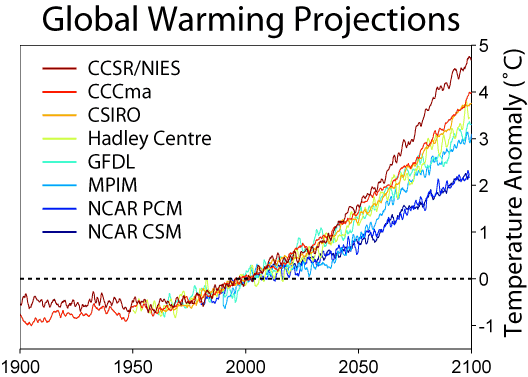
Independent (UK): The world is now firmly on course for the worst-case scenario in terms of climate change, with average global temperatures rising by up to 6C by the end of the century, leading scientists said yesterday. Such a rise -- which would be much higher nearer the poles -- would have cataclysmic and irreversible consequences for the Earth, making large parts of the planet uninhabitable and threatening the basis of human civilisation. We are headed for it, the scientists said, because the ...
Read more [EcoEarth.info]
Inter Press Service: Africa, the continent already most affected by hunger and food scarcity, is likely to see its woes increased due to climate change and the changing rain patterns it provokes, experts and scientists say. According to data gathered by the German Institute for Meteorology and Climate Research, variability in the rain patterns in Africa, especially in the Western region, has substantially increased since the early 1980s. Harald Kunstmann, director of the institute, says that while ...
Read more [EcoEarth.info]
Independent (UK): Two years ago, the United Nation's International Panel on Climate Change forecast an increase in global temperatures by the end of the century of between 1.8C and 4C, depending on the success of nations in reducing their carbon emissions. But now an international team of scientists, led by Professor Corinne Le Quéré of the University of East Anglia, argues that the world is in fact on course for a 6C rise in temperature by 2100. These might sound like small numbers. But their implications ...
Read more [EcoEarth.info]
STOCKHOLM (Reuters) - The European Union's Swedish presidency urged Russia on Wednesday to do more to combat climate change and discussed Russian energy supplies to Europe, which could be threatened by a dispute with Ukraine.
Read more [Reuters]
LONDON (Reuters) - Women bear the brunt of drought, rising seas, melting glaciers and other effects of climate change but are mostly ignored in the debate over how to halt it, the United Nations Population Fund (UNFPA) said on Wednesday.
Read more [Reuters]
A calendar of actions during the Copenhagen conferenceThousands of activists from all over the world will soon descend on Copenhagen with one message: that world leaders must agree a deal that will be effective in reducing global emissions, and be fair for the people most vulnerable to climate change.
Read more [EarthWire]
Ahead of next month's climate change talks in Copenhagen, the BBC's Damian Kahya takes a look at the carbon trading sector.
Read more [EarthWire]
Independent (UK): The world is now firmly on course for the worst-case scenario in terms of climate change, with average global temperatures rising by up to 6C by the end of the century, leading scientists said yesterday.
Read more [EarthWire]
Ahead of next month's climate change talks in Copenhagen, the BBC's Damian Kahya takes a look at the carbon trading sector.
Read more [EarthWire]
LONDON (Reuters) - Seed banks need a further $250 million to preserve all varieties of food crops including those which may best survive future climate changes, the Global Crop Diversity Trust said Wednesday.
Read more [Reuters]
Brasilia, Brazil: The recent announcement by Brazil – one of the world’s top emitters of greenhouse gases from deforestation - that it is adopting new emissions reduction targets could help steer negotiators in Copenhagen toward a stronger climate change deal.
Brazil’s top environment ministers said late last week the country is committing to an emission reduction target of between 36.1 and 38.9 percent by 2020. Brazil announced those figures only a day after saying new data showed the lowest deforestation rates in the Amazon in the past 21 years.
The new commitment can help unblock and steer climate negotiations toward a new global agreement in Copenhagen, which will be considered next month, said WWF-Brazil CEO Denise Hamú.
"As Brazil announces these figures, it moves from a situation where it merely holds developed countries to account to a situation where it can be a role model in the establishment of a new low-carbon development model for the world," Hamú said.
"It should be noted, however, that the data needs to be more detailed,” she said. “We are not sure which baseline scenario was used, that is, how the Brazilian government estimated Brazil's emission growth trends by the end of the next decade. Neither do we know how we will reach those targets.”
“No detailed information is available on all actions across the various industries and on our low-carbon plan of action. It is fundamental that all government policies be consistent with the announcement made today," Hamú said.
As far as international climate negotiations are concerned, Brazil now has a more legitimate case to demand a clearer financial support commitment from the developed nations for the establishment of adequate actions to adapt to the effects of global warming, according to WWF.
Data released by the Brazilian government earlier this month showed that the deforestation rate in the Amazon fell between August 2008 and July 2009. Overall, the deforested region is a 45 percent smaller than Amazon land cleared the previous year, or between August 2007 and July 2008.
This is the lowest rate of deforestation in the Amazon since record-keeping began in 2000, and down from a high of more than 27,000 square kms in 2004.
However, deforestation also must be reduced in other damaged forest areas in Brazil, such as in the Cerrado, according to WWF:
Despite conservation efforts, global deforestation continues at an alarming rate – 13 million hectares per year, or 36 football fields a minute. It generates almost 20 per cent of global greenhouse gas emissions and halting forest loss has been identified as one of the most cost-effective ways to keep the world out of the danger zone of runaway climate change.
Read more [WWF]
Leaders of China and the U.S. announced today that their countries will work hard alongside other nations to produce a substantive international climate agreement at a major United Nations climate conference next month. In response, Jonathan Lash, president of the World Resources Institute, said, “The outcome of today’s discussions between President Barack Obama and President Hu Jintao on climate and energy sends an encouraging signal for a positive result at the upcoming climate summit in Copenhagen. “The statements by the two leaders and the joint communiqué following their meeting reflect a shared sense of urgency about achieving progress toward a comprehensive agreement on climate change, and a shared vision of the transition to a low carbon economy as a source of innovation and economic opportunity,” Lash added. “It is particularly encouraging that both leaders signaled their commitment to national action to reduce heat-trapping pollutants, and to cooperation on a wide range of projects to promote technologies to achieve that goal.” For much more information on the upcoming climate talks, visit the Countdown to Copenhagen page on WRI’s Web site.
Read more [wri.org]